Postwar changes in Gion
Memoirs of a GeishaPostwar changes in Gion are marked by a double estrangement: the district remains physically recognizable, yet poverty, American military presence, and the conversion of a major theater have changed its social and professional world. For Sayuri, Gion is at once a place she has been barred from and a stage preserved in memory; her return restores her to its streets without restoring the world she left.
Wartime separation and a rare visit
After the surrender, Japan’s geisha districts reopened within a few months, but Sayuri could not return to Gion until Mother summoned her. While Mother and Auntie made money selling kimono, artwork, and Japanese swords to American soldiers, Sayuri continued living and working with the Arashino family. Though Gion lay only a few kilometers away, she visited it just once during nearly five years away.
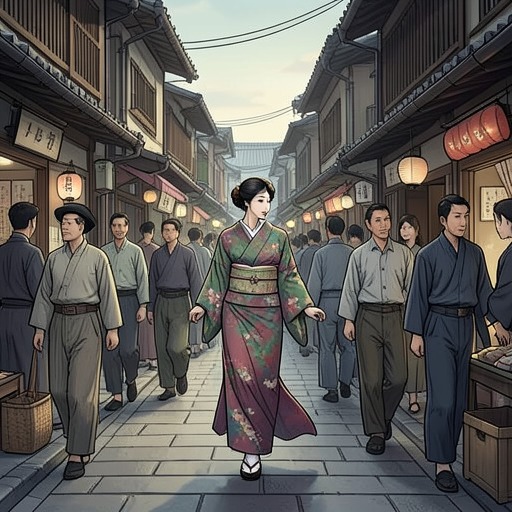
That visit came in the spring, about a year after the war ended, while Sayuri was returning from the Kamigyo Prefectural Hospital with medicine for Juntaro. She walked along Kawaramachi Avenue to Shijo, crossed the bridge into Gion, and encountered families living in poverty along the riverbank. The sight established a changed social landscape before she had even reached the district’s familiar streets: postwar Gion was not simply the old community waiting intact for her return.
A district experienced through memory
Sayuri recognized some of the geisha she passed, but they did not recognize her, and she chose not to speak to them. She hoped to look at Gion as an outsider might; instead, its streets brought back remembered scenes. Along the banks of the Shirakawa Stream she recalled afternoons with Mameha; a nearby bench recalled the evening she had asked Pumpkin for help over bowls of noodles. An alley brought back Nobu’s rebuke for her choice of the General as her danna, and a corner of Shijo Avenue recalled the delivery man whose lunch boxes she had made him drop.
The remembered locations transform the walk into a survey of Sayuri’s former life. She imagines herself on a stage after the dance has ended, with silence settled over it, and then goes to the okiya, where a heavy iron padlock bars the door. The lock makes the change in her status visible: once confined inside, she now longs to be admitted. Yet she is an adult, free to leave Gion and never return. The reversal does not erase her old confinement; it changes what the closed door means.
Poverty, occupation, and altered institutions
When Sayuri later resumes contact with Gion, the district’s changes appear in both its institutions and its everyday public life. Mameha has returned but lives in a one-room apartment above a pharmacy near Gion Shrine, without a danna to pay for more spacious accommodations. The change is legible in their reunion: Mameha’s face retains its familiar oval shape, while her cheekbones protrude, her neck has grown sinewy, and pain from teeth loosened during the war still affects the way she holds her mouth.
Mameha also describes the altered prospects of geisha work. With American soldiers in Gion, she says, English will be more useful than dance, and the Kaburenjo Theater has become a cabaret. The theater’s conversion stands for a wider displacement: a venue associated with geisha performance is being used for a different entertainment economy under occupation. The district has reopened, but reopening does not mean a return to its prewar professional order.
Sayuri’s own later visit to a teahouse makes that new social environment startlingly concrete. At the entrance, army boots have replaced the familiar row of men’s shoes. Inside, she sees an American soldier in his underwear wedged beneath an alcove shelf while two geisha laugh and try to pull him free; he has apparently lost his clothes in a drinking game. They draw him out by the arms and lead him down the hall, where whistling and cheering greet his arrival. The episode presents occupation as an intrusion into the spaces and customs of Gion, but also as a new form of noisy, comic spectacle staged inside a teahouse.
Return, continuity, and changed belonging
About a week after returning, Sayuri prepares to appear again as a geisha. She moves between the hairdresser, fortune-teller, and search for makeup, soaking her hands to remove stains and trying Western-style face powder to conceal how thin she has become. Now nearing thirty, she is no longer expected to wear white makeup except on special occasions. When Mr. Bekku dresses her, the young Etsuko watches with the same astonishment Sayuri once felt watching Hatsumomo; Etsuko’s reaction, more than Sayuri’s own reflection, convinces her that she looks like a geisha again.
Her first evening back unfolds in falling snow. A shawl and lacquered umbrella make her difficult to recognize, and she recognizes only about half the geisha she passes. Those who lived in Gion before the war offer a small courtesy bow even when they do not seem to know her; the others give no more than a nod. The difference registers a break in communal familiarity, while the bows preserve a remnant of an older social code.
At the Ichiriki, the entryway is lined not with the expected signs of an unchanged teahouse but with the polished black shoes of officers. Yet the rooms seem quieter than they had during Sayuri’s apprenticeship. She waits in a large ground-floor room, valuing its beauty after years of deprivation, and soon hears that Nobu has brought Deputy Minister Sato. Her return therefore begins not with a simple restoration of the old Gion, but with work conducted amid new patrons, altered manners, and the continuing importance of personal ties. The district is open again, and Sayuri can enter it as a geisha, but its changed population and her own long absence make belonging something she must encounter anew.